A useful future vision does not lock a team into an answer. It makes a capability concrete enough to recognize later, when the right product moment arrives.
Sketched 2021 Realized 2026 Working artifact
Airspace’s core business moves time-critical shipments with independent contractors we find and dispatch automatically. Usually customers hand over a package and the network and technology do the rest. So in 2021, when a wish kept surfacing in interviews with our sales and customer-success teams, it cut against the grain: customers wanted to work with their own preferred drivers and agencies. It was not yet a formed product request, and it did not belong to any one kind of customer. It was a capability we suspected could matter across the business.
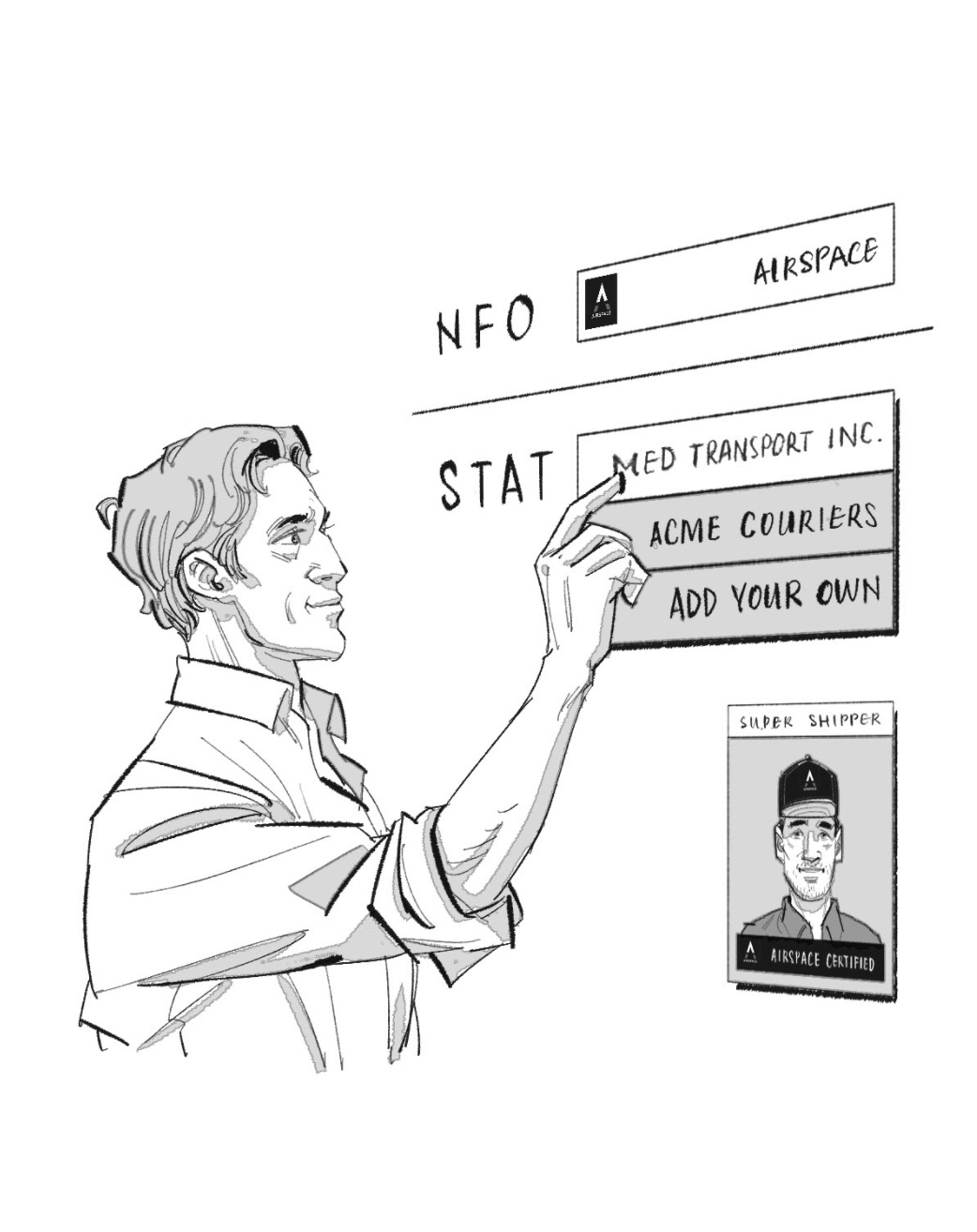
To make the possibilities from those interviews easier to discuss and remember, I commissioned an illustrator to draw nine future-vision sketches of where the product could go. The one below imagines a customer adding their own preferred driver. It is deliberately sketchy: more concrete than a line in a roadmap, and less rigid than a specification. It is something we might aim for, even if we knew it would not be possible in the next quarter.
Future-vision sketch / 2021 / selected from a commissioned set of ninePublished with permission
Keep the capability, even if it won’t arrive tomorrow.
Years later, we began Fleet Manager, a platform that lets customers run their own courier operations. Soon that sketch pasted on the wall had one more thing in it. We knew customers wanted to add their own drivers, but we also knew sometimes they would want to work with outside agencies. That meant we would need a system capable of handling both. An employee or contractor working with the company might allow for direct communication and routing. An agent working through an outside agency would likely not allow the same degree of control.
So when we came to implementation, we ensured it would work with agents from the start. Each driver joins through a specific relationship, and the relationship carries the rules: how they can be dispatched, how they can be paid, and what gets monitored. Time tracking, for example, turns on or off with the relationship instead of being forced into one default.
The sketch did not dictate that data model. What it did was keep the possibility open and top of mind: customer-managed drivers were a capability worth carrying forward, not an edge case to rediscover from scratch when a new product was already under pressure to ship.
Try it / One person, two relationships
Change only the relationship.
Here is the same driver, doing the same route, joining through two different relationships. Read across a rule to see what the relationship, not the person, decides. Click any rule to see why it moves.
Held constantSame driver. Same route. Same job.
The rule
Relationship AIndependent contractor
Relationship BPartner-company agent
Same person, same route, and every rule still changes. The relationship, not the role, is the object the system is really managing.
01 / Start with signal
Listen for a capability that may outlast the immediate request.
Sales and customer-success interviews gave the team a recurring need to investigate: customers wanted a way to work with their preferred drivers.
02 / Make it tangible
Give the team something more useful than a sentence on a roadmap.
The sketch made the future experience discussable across product, design, and the people closest to customer reality.
03 / Preserve the difference
Let people who share a job work under different rules.
A contractor and a partner agent may drive the same kind of route, but the system has to dispatch, pay, and monitor them differently.